

Industrial Policy Lab

News
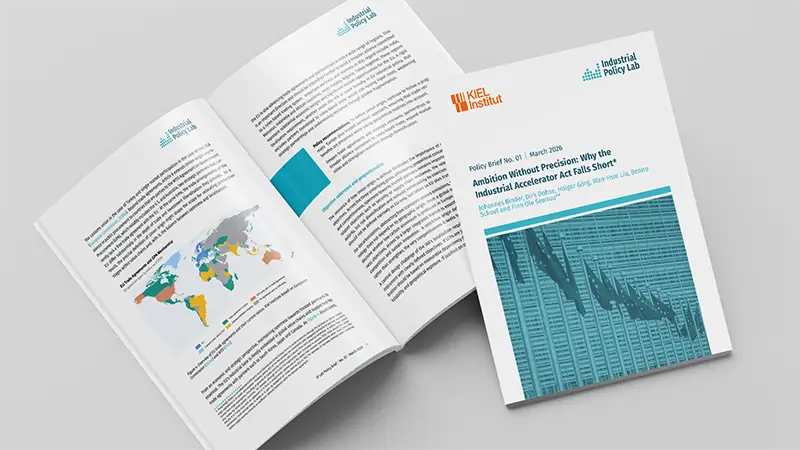
Ambition Without Precision: Why the Industrial Accelerator Act Falls Short
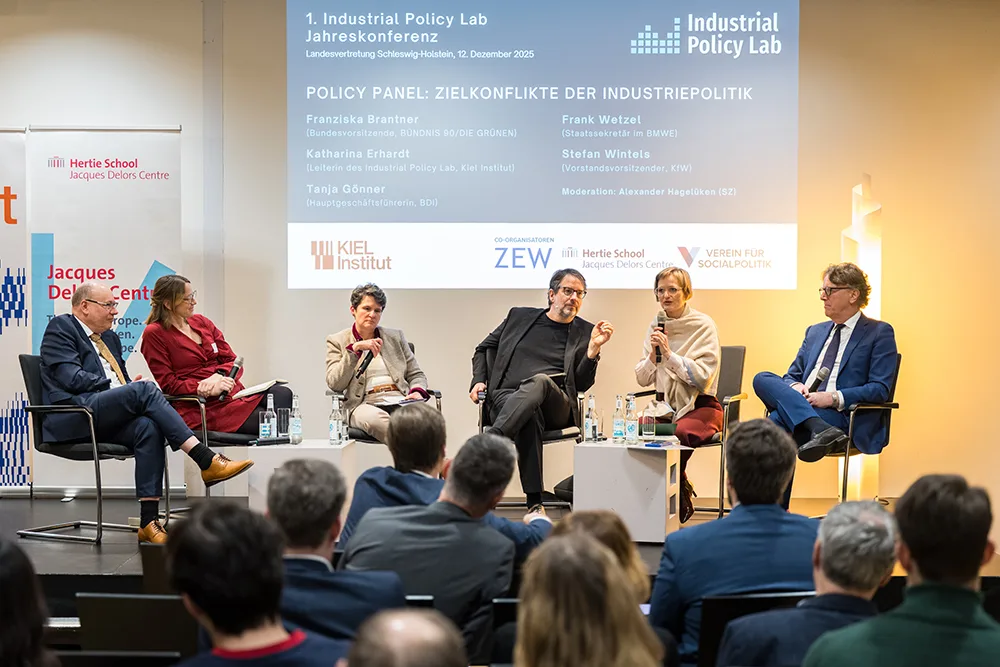 © Kiel Institut | Stefanie Loos
Looking Back: 1st Industrial Policy Lab Annual Conference
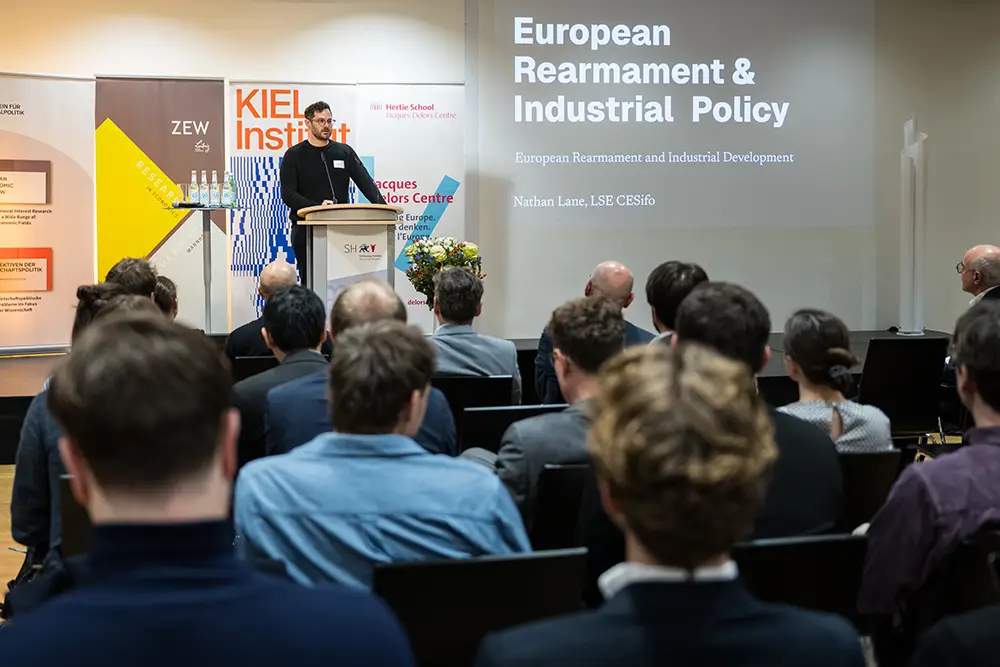 © Kiel Institut | Stefanie Loos
Rewatch Nathan Lanes Keynote at the IP Lab Conference 2025
Events
- 26.04.2026 @ 11:00 - 12:00
The Industrial Accelerator Act: Will the EU manage to reshape economic relations with China in strategic sectors?
Online | Finn Ole Semrau (IP Lab) and Alexander Hoeckle (BGA) on the Industrial Accelerator Act and its implications for EU–China industrial relations.
About the Project
The Industrial Policy Lab is establishing a center of excellence for evidence-based and policy-relevant research on industrial policy. Anchored at the Kiel Institut, the Industrial Policy Lab combines rigorous economic research, continuous monitoring of industrial policy measures, and the development of an innovative scoring tool to assess costs, benefits, and trade-offs of policy interventions.
Beyond research, the Lab serves as a hub for informed debate, connecting academia, policymakers, business, and society. By translating complex research into accessible formats, the Industrial Policy Lab lays the foundation for an objective, fact-based, and forward-looking industrial policy discourse.
The work of the Industrial Policy Lab is structured around three closely connected modules: Research, Monitoring and Scoring. Together, they form an integrated framework for understanding, evaluating, and debating industrial policy.
 © Kiel Institut | Daniel Wolcke
 Research
The Analytical Foundation
Economic research is the backbone of the Industrial Policy Lab. We focus on policy-relevant topics such as global value chains, trade dependencies, innovation, resilience, geoeconomics, and the green transition. Our work combines state-of-the-art empirical analysis, learning from past policy experiences, with theoretical modeling to understand underlying economic mechanisms. Through international cooperation, conferences, and seminars, we bring together leading researchers and contribute to the global frontier of industrial policy research.
 © TommL | iStock
 Monitoring
Making Industrial Policy Transparent
Industrial policy has expanded rapidly across countries and sectors, yet systematic and comparable information on concrete policy measures remains scarce. Decisions are often made in a fragmented information environment, making it difficult to identify emerging trends, compare approaches across countries, or assess how today’s interventions relate to past policy experience. To address this gap, the Industrial Policy Lab is building a data-driven monitoring infrastructure that documents industrial policy measures in a structured and transparent way. A central element will be a continuously updated tracker capturing ongoing interventions and new policy initiatives. This will be complemented by a historical database that records past industrial policy measures and enables long-term analysis. Based on these data, an annual Industrial Policy synthesizes key developments and insights.
 © Headway | Unsplash
 Scoring
Evaluation What Works
The Industrial Policy Lab is developing a quantitative evaluation framework designed to bring structure and transparency to these debates. At its core is IPMAX, a scoring tool intended to enable systematic cost– benefit analyses across different policy tools, objectives, and economic contexts. The approach aims to reflect the multidimensional nature of industrial policy by accounting for sectoral and technological differences, innovation effects, and interdependencies within production networks, while making trade-offs between policy goals and economic costs explicit. As this framework evolves, it seeks to provide a common analytical reference point that helps shift industrial policy discussions from ideology and anecdote toward evidence-based assessment.
Partners



The project is funded by the Federal Ministry for Economic
Affairs and Energy under the grant number 01PLAB01
Stay informed on Industrial Policy
Get expert insights, new publications, and invitations to the latest events from the Industrial Policy Lab.
Subscribe to Newsletter